Posts

Philippine Democracy beyond President Duterte
Image
By Menelito Mansueto Dr. Jose Veloso Abueva – the past President of the University of the Philippines System and Chancellor of University of the Philippines-Diliman, had fought a lifetime struggle to campaign and advocate for a federal type of government in the Philippines. He is the elder brother of nationally awarded sculptor, Napoleon V. Abueva. These men, along with physicist Dr. Christopher C. Bernido, are among a few true-blue educators and public intellectuals who were born and raised in Bohol. Dr. Jose V. Abueva died last year at the old age of 93 after a lifelong advocacy for the federal form of government. He was one of the most seasoned intellectuals in UP Diliman, a seasoned political scientist in his case. But his advocacy for federalism was heard too little, even within his own circle in UP Diliman. Recalling back sometime around 2013-2014, nobody had believed in him even within his own core group, the best of his friends, that he could seek the changes that he had wanted...
Democracy in the Academe?

Image
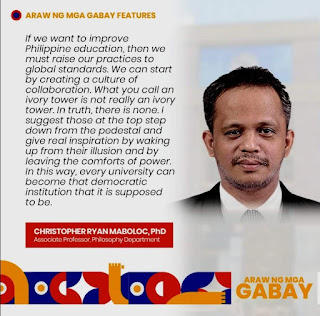
By Dr. Christopher Ryan Maboloc  There are different levels of influence in the world of academia. This helps us understand how knowledge and tradition are established in systematic thought and analytic thinking. For instance, Fr. Michael Moga has not published his works in scholarly journals, but his books have been the standard readings for over 50 years in many Mindanao schools, especially the three Ateneos. The same can be said for Luzon and Visayas scholars. Universities are actually protective of the legacy of their own intellectual giants.  This has changed as more young academics went abroad to study, especially when the European Commission offered the Erasmus Mundus scholarship program. It would be tough to measure the value of an academic output if the concept of tradition is employed today. It will take time and the same honor can only be reserved for very few people, who we young academics consider as 'gods'. But for mortals like us, we can only rely on peer evalua...

Super Typhoon Odette's path of destruction leaves thousands homeless

Image
By Menelito Mansueto Jr., co-editor  SuperTyphoon Odette, with winds reaching 270 kph, left a tremendous damage to the various provinces and regions of the Visayas and Northern Mindanao last December 16, 2021. The catastrophe has not only brought damage to properties and great suffering to thousands of victims, it also resulted to severe emotional, mental, and psychological stress as families now deal with death of loved ones and traumatic loss. Power and communication lines have been toppled and major cities hit by the typhoon are without water.  We enjoin all Filipinos as well as our foreign friends, to help in relief efforts. The people of Bohol, in particular, have been known to welcome tourists with their contagious smiles. But now they ask and plead for your kind-heartedness. Practically, many areas in Bohol have been damaged by the typhoon, especially Ubay, Alicia, and Loboc. What previously was an image of green vegetation in Bilar and Loboc town's Man-made Forest, and...

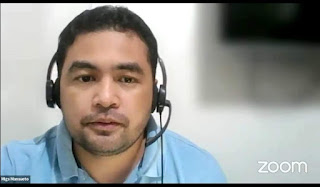
Menelito Mansueto is co-editor of Philippine Democracy Online

Image
  Mr. Menelito Mansueto, a full-time faculty member of the Philosophy Department at Mindanao State University, is the co-editor of Philippine Democracy Online, a blog that publishes short essays and articles on Philippine democracy and politics, poverty and human rights, education and human development issues. The well-read blog was created by Dr. Christopher Ryan Maboloc in 2008 while studying in Europe and initially featured the writings of the late Dr. Romulo Bautista, co-founder of the Social Ethics Society.  Submissions (limited to 700 words) can be sent to migs_mansueto@yahoo.com.

Natural Disasters and Inequality

Image
Disasters and Ethics Natural disasters bring into clear view the inequalities of every society but any crisis is also an opportunity for every individual to engage in meaningful practices and acts of kindness. The ideal of the good points to the need for effective measures as well as the respect for the rights of people. A moral society has a compassion for those who are in difficult situations and the understanding of the duty of justice. Government efforts need the cooperation of the public and the private sector has to rise above its corporate goals to be in solidarity with society as it pursues the path toward recovery and sustainability. Why demand climate justice? The hardest hit are the poor who do not have safety nets nor property insurance schemes. They can only depend on government for any type of assistance. But one missing narrative here is the fact that unusual weather patterns and catastrophes are a result of the changing climactic conditions brought about by decades of e...

Duterte is not the Enemy: The Problem is Elite Democracy

Image
By Christopher Ryan Maboloc, PhD For most Filipinos, Manila evokes images of high rise structures, elite schools, flyovers and a very horrendous traffic situation, while Mindanao is often associated with the Moro rebellion, the rural life and indeed, massive poverty. But as the research of Asuna Yoshizawa and Wataru Kusaka shows, there is actually cooperation between Christians and Muslims in their everyday life. A modern myth identifies EDSA and the Aquinos with freedom and democracy, but in view of his radicalism, President Duterte with unfounded insinuations of tyranny.  When Walden Bello described how fascism emerged in Europe, he mentioned Hitler and Mussolini. Yet, the book of Michael Wildt tells us that racial exclusion was prevalent as early as 1911. In Hitler's Volksgemeinschaft and the Dynamics of Racial Exclusion, Wildt argues that rural villages were practicing racial prejudice, long before the rise of Hitler and Nazism in Germany. None of that sort exists in the countr...

The Theory of Radical Politics in the Philippines

Image
Gerry Flores Arambala Chairperson Philosophy Department La Salle University - Ozamiz         Christopher Ryan Maboloc, the main proponent of the theory of radical democracy in the Philippines, explains that the Spanish colonial regime did not only exploit the Filipino people through unfair taxes and hard labor, but also by elevating the chosen elites called principales to rule the masses (Maboloc 2019). “The elite among Filipinos who benefited from foreign rule are the ones who have hastened the subjugation of the islands” (Maboloc 2019).   Maboloc writes that such “patronage system is not a modern-day phenomenon. It can be traced back to the administration of Spanish authorities, which can be summed up as the politics of exclusion” (Maboloc 2019). Such type of politics, echoing Hotchcroft and Rocamora (2003), characterizes the logic of Philippine democracy. What that means is that, politics is monopolized by the few elites and the oligarchs of the country, w...